An Introduction
When people need a product, service, course, or solution, Google is often the first place they search. For businesses, appearing on the first page of Google can bring valuable visitors and potential customers. This is where Google Ads and Search Engine Optimization become important.
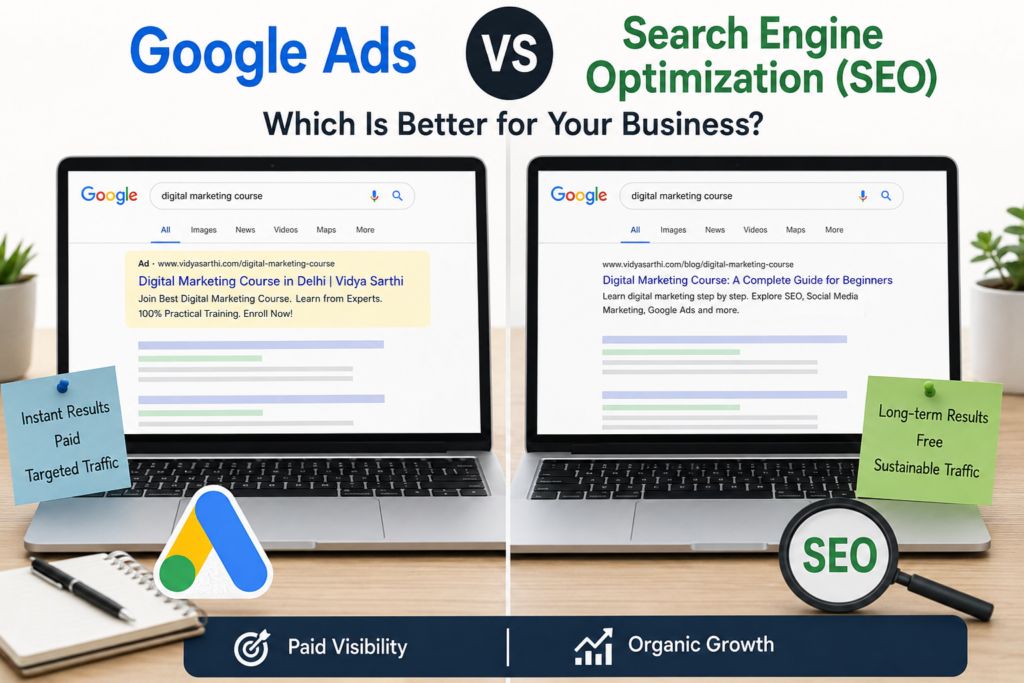
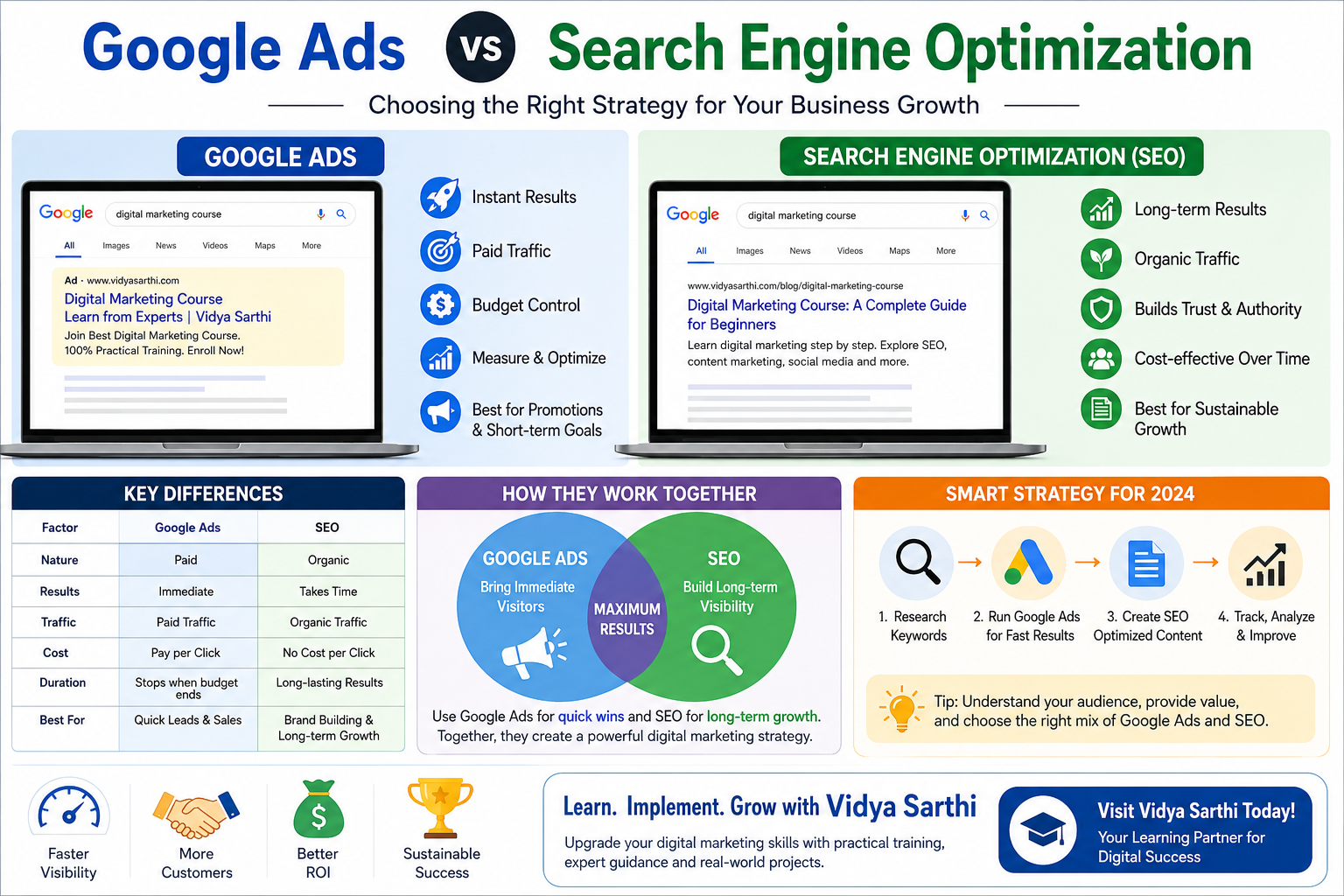
Although both strategies help a website gain visibility on Google, they work differently. Google Ads uses paid advertising to place businesses in front of potential customers, while Search Engine Optimization focuses on improving a website so that it can appear naturally in organic search results.
So, which strategy is better? The answer depends on your goals, budget, competition, and how quickly you need results
What Is Google Ads?
Google Ads is a paid advertising platform that allows businesses to display advertisements when people search for relevant products, services, or information.
For example, imagine a student searches for “digital marketing course in Delhi.” Businesses offering relevant courses can create paid search advertisements that may appear prominently in the search results.
The advertiser generally pays when someone interacts with the advertisement, such as clicking it. This makes Google Ads useful for businesses that want to generate traffic, enquiries, or sales quickly.
Major Benefits of Google Ads
1. Faster visibility:
A properly configured campaign can start generating visibility much faster than a new organic SEO page.
2. Targeted audience:
Businesses can target people according to factors such as location, keywords, language, and other campaign settings.
3. Budget control:
Advertisers can establish campaign budgets and monitor performance.
4. Useful for short-term campaigns:
Google Ads can be particularly useful for limited-time offers, admissions, product launches, and promotional campaigns.
However, paid visibility comes with an ongoing cost. Once advertising stops, the paid traffic generated by the campaign can also stop.
What Is Search Engine Optimization?
Search Engine Optimization, commonly called SEO, is the process of improving a website and its content so that search engines can understand it and users can find it through organic search.
Unlike paid advertising, Search Engine Optimization does not require paying for every organic click. Instead, businesses invest time and resources into content, website improvements, technical performance, and user experience.
Major Benefits of Search Engine Optimization
1. Long-term potential:
A useful page that earns strong organic visibility can continue attracting visitors over time.
2. Builds authority:
Helpful, well-structured content can strengthen a brand’s credibility.
3. Improves the website:
SEO encourages businesses to improve content, navigation, mobile responsiveness, page speed, and overall usability.
4. Supports content marketing:
Blogs, guides, educational pages, and landing pages can target different search queries and attract users at different stages of the buying journey.
When Should You Choose Google Ads?
Google Ads can be a strong option when your primary objective is immediate visibility.
For example, suppose an educational institute has started admissions for a new course. Waiting for a newly created page to rank organically may not be ideal if the admission period is short.
In such a situation, paid advertising can help the institute reach relevant users more quickly.
Google Ads can be useful when:
- You need quick traffic.
- You are launching a new product or service.
- You have a limited-time offer.
- You want to test keyword demand.
- You need enquiries or leads quickly.
However, campaigns should be monitored regularly. Businesses should examine search terms, keyword performance, advertisements, conversions, and budget allocation instead of simply running an advertisement without optimization.
When Should You Choose Search Engine Optimization?
Search Engine Optimization is more suitable when the goal is sustainable online visibility.
Suppose a business creates useful articles about digital marketing, career opportunities, courses, or industry-related questions. With proper optimization and valuable content, those pages can potentially attract organic visitors over time.
SEO is especially useful when:
- You want long-term website traffic.
- You regularly publish useful content.
- You want to build online authority.
- You want to reduce dependence on paid traffic.
- Your business can wait for organic growth.
Which Is More Cost-Effective?
Cost-effectiveness depends on the business model and marketing objective.
Google Ads requires an advertising budget. The advantage is that businesses can potentially generate traffic quickly and measure campaign performance.
Search Engine Optimization requires investment in content creation, website optimization, technical improvements, and ongoing maintenance. Its major advantage is that organic visitors do not require a direct advertising payment for every click.
For a new business that needs customers immediately, Google Ads may provide greater short-term value. For a business focused on building a strong digital presence over several months or years, Search Engine Optimization may offer greater long-term value.
Can You Use Google Ads and SEO Together?
Yes. In fact, using both can create a balanced digital marketing strategy.
Google Ads can provide immediate visibility while Search Engine Optimization works in the background to develop organic traffic.
For example:
- Use Google Ads to promote an important service.
- Identify keywords that attract relevant visitors.
- Create useful SEO content around relevant search queries.
- Optimize the website and landing pages.
- Track performance and improve both strategies.
This approach allows businesses to focus on immediate opportunities without ignoring long-term growth.
Google Ads vs Search Engine Optimization: The Final Verdict
So, Google Ads vs Search Engine Optimization — which one should you choose?
If you need quick visibility, immediate traffic, or short-term promotion, Google Ads can be the better choice.
If you want long-term organic visibility, useful content, and sustainable website growth, Search Engine Optimization is the stronger approach.
However, businesses do not always have to choose one.
A combination of Google Ads and Search Engine Optimization can provide the best of both approaches. Paid campaigns can support immediate marketing goals, while SEO builds a foundation for future organic growth.
The most important principle is to understand your audience first. Research what people are searching for, create useful content, and then select the strategy that matches your business objective. This follows the core idea of the Yoast framework: create content for humans while structuring it properly for Google.

Ready to Build Your Digital Marketing Career?
Want to master Google Ads, Search Engine Optimization (SEO), and other digital marketing skills? Take the next step with Vidya Sarthi and turn your knowledge into practical skills.Whether you are a student, beginner, or aspiring digital marketer, Vidya Sarthi can help you move closer to your career goals.
Learn. Practice. Grow. Build your digital future with Vidya Sarthi.
👉 Join Vidya Sarthi Now and Start Learning!