Will AI-Generated Videos Get Monetized on YouTube in 2027?
Introduction
AI-generated videos are changing the way people create content on YouTube. From animated stories and educational videos to documentaries, explainers, and faceless channels, artificial intelligence has made video creation faster and more accessible than ever.
But one question is becoming increasingly important for creators in India and around the world: Will AI-generated videos get monetized on YouTube in 2027?
The short answer is yes, AI-generated videos can potentially be monetized in 2027. However, simply using AI to generate a video does not automatically make a channel eligible for monetization. The real question is whether the content provides genuine value, originality, and meaningful viewer engagement.
In this blog, we will explore how AI-generated content may fit into YouTube monetization, what creators should avoid, and how to build an AI-assisted channel that has a better chance of succeeding.
What Is AI-Generated Video Content?
AI-generated video content refers to videos created partly or largely with artificial intelligence tools. These tools can help creators generate scripts, voiceovers, images, animations, subtitles, music, and even complete video sequences.
For example, a creator could use AI to:
- Generate ideas and research topics
- Write or improve a video script
- Create illustrations and animations
- Produce an AI voiceover
- Add subtitles and background music
- Edit clips and organise the final video
This is particularly useful for beginners who may not have expensive cameras, editing software, or a professional production team.
However, using AI as a production tool is different from simply producing large quantities of repetitive, low-effort videos.
Can AI-Generated Videos Be Monetized in 2027?
AI itself is not necessarily the problem. The quality and originality of the content matter far more.
YouTube’s monetization system is designed to reward content that provides value to viewers. Therefore, an AI-generated video can be monetized when it demonstrates originality, effort, and a meaningful purpose.
For example, imagine two channels.
The first channel automatically creates hundreds of videos using the same template, AI voice, stock visuals, and generic scripts. Each video contains little original information or creative input.
The second channel uses AI tools to research topics, create visuals, assist with scripting, and improve editing, while the creator adds original storytelling, analysis, commentary, or educational value.
The second approach is much more aligned with what creators should aim for.
Therefore, the important question should not be “Is this video made using AI?” but rather “Does this video offer something valuable and original to the audience?”
AI-Assisted Content vs. Low-Effort AI Content
This distinction will become increasingly important for creators in 2027.
AI-Assisted Content
AI-assisted content uses artificial intelligence as a tool while the creator remains involved in the creative process.
Examples include:
- Adding personal commentary to an AI-assisted script
- Creating original educational explanations
- Using AI-generated illustrations for storytelling
- Editing and improving AI voiceovers
- Combining research with original analysis
- Developing unique video concepts
Here, AI functions more like a production assistant.
Low-Effort AI Content
Low-effort content generally involves producing repetitive videos with minimal human contribution.
Examples may include:
- Copying information from other websites
- Uploading automatically generated videos in bulk
- Using identical templates repeatedly
- Creating videos with no meaningful commentary
- Reusing other people’s content with minor changes
- Producing misleading or inaccurate AI-generated information
Such approaches can make a channel appear repetitive or lacking in meaningful originality.
What Indian Creators Should Know
India has one of the world’s largest and fastest-growing YouTube audiences. This creates significant opportunities for creators who can produce useful content in English, Hindi, Hinglish, and regional languages.
AI can be especially helpful for Indian creators because it can reduce the cost and time required for production.
For example, a creator could build a channel around:
- Indian history and culture
- Educational explanations
- Business and entrepreneurship
- Technology
- Personal finance education
- Travel stories
- Mythology and storytelling
- Career guidance
- Animated children’s stories
- Current-affairs explainers
However, creators should not simply translate or reproduce information found elsewhere. Adding original research, storytelling, opinions, explanations, and presentation can make the content substantially more valuable.
How to Increase the Chances of Monetization
If you are planning an AI-based YouTube channel for 2027, focus on the following principles.
1. Add Human Creativity
Use AI to assist your work, but do not let automation completely replace creativity.
Your contribution can come through storytelling, research, editing, commentary, humour, presentation, or unique perspectives.
2. Create Original Scripts
Avoid simply asking AI to rewrite existing articles and uploading the result.
Instead, research the subject, verify important information, organise your own structure, and create a script that gives viewers a reason to watch your video.
3. Avoid Repetitive Videos
Publishing many nearly identical videos may help increase output, but quantity alone does not guarantee a successful or monetizable channel.
Focus on making each video useful and meaningfully different.
4. Improve Visual Quality
AI-generated images and animations should support the story rather than merely fill the screen.
Use appropriate visuals, transitions, subtitles, charts, and editing to keep the viewer engaged.
5. Fact-Check AI Output
Artificial intelligence can generate incorrect or misleading information. This is particularly important when creating educational, financial, historical, or news-related content.
Always verify important claims before publishing.
6. Build a Recognisable Channel
A strong channel needs an identity.
Develop a consistent style, topic, voice, thumbnail approach, and storytelling format. Viewers should be able to understand why they should subscribe to your channel rather than another AI-generated channel.
Will YouTube Ban AI Videos?
Creators sometimes assume that YouTube will completely ban AI-generated videos. That is an oversimplification.
AI is becoming a normal part of modern content production. The more important concern is whether the content is deceptive, repetitive, reused, misleading, or provides little value.
Therefore, creators should not build their strategy around trying to “hide” the fact that AI was used.
Instead, use AI transparently as a tool to produce better content.
What Could Happen in 2027?
By 2027, AI video creation is likely to become even more advanced. Generating realistic characters, voices, animations, and complete scenes may become significantly easier.
As the technology improves, however, the amount of AI-generated content on the internet will also increase.
This could make originality even more important.
When thousands of creators can generate a video in minutes, the competitive advantage may no longer be simply having access to AI. It will be the ability to develop interesting ideas, strong storytelling, credible information, and a unique connection with viewers.
In other words, AI may make video production easier, but it will not necessarily make audience building easier.
Conclusion
So, will AI-generated videos get monetized on YouTube in 2027?
The answer is likely to be yes, provided the content meets YouTube’s applicable monetization requirements and offers genuine value to viewers.
Creators should remember one simple principle: AI should be a tool, not the entire creative strategy.
Use AI to save time, improve production, generate ideas, create visuals, and assist with editing. But add your own research, creativity, storytelling, judgement, and originality.
For Indian creators especially, this presents a significant opportunity. A creator with a smartphone, AI tools, a strong idea, and consistent effort can potentially build an audience without requiring a traditional studio setup.
The future of YouTube may not belong to creators who use AI the most. It may belong to creators who use AI intelligently while creating something that audiences genuinely want to watch.
Call to Action
Planning to start an AI YouTube channel in 2027? Start building your skills today. Experiment with AI tools, learn video editing, develop your storytelling ability, and most importantly, focus on creating content that provides real value.
Use AI to create faster—but use human creativity to create better.
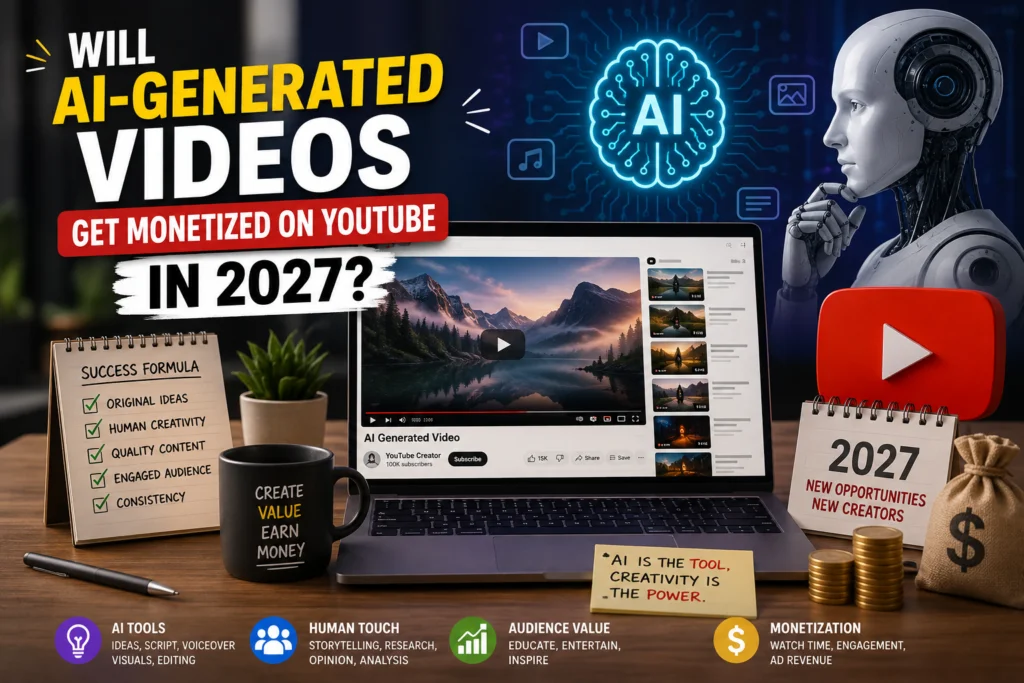
Quick Summary -Will AI-Generated Videos Get Monetized on YouTube in 2027?
AI-generated videos are expected to remain a major part of YouTube content creation in 2027. Such videos can potentially be monetized, but using AI alone does not guarantee monetization. The key factors are originality, quality, viewer value, and meaningful creative effort.
The blog explains the difference between AI-assisted content and low-effort, repetitive AI content. Creators can use AI for scripts, voiceovers, visuals, editing, research, and ideas, but they should add their own creativity, storytelling, analysis, and presentation. Repetitive videos, copied information, mass-produced content, and videos with little original contribution may create difficulties for monetization.
For Indian creators, AI presents a valuable opportunity to create content in English, Hindi, Hinglish, and regional languages across areas such as education, technology, business, history, storytelling, travel, and career guidance. However, creators should verify AI-generated information and focus on producing genuinely useful content.
The central message of the blog is simple: AI should be used as a tool, not as a replacement for human creativity. As AI video creation becomes easier, originality and audience value are likely to become even more important.
In short, creators who combine AI technology with human creativity, authentic storytelling, research, and valuable content can build stronger and more sustainable YouTube channels in 2027.